
Rack Attack Blade Sign Installation in Berkeley
This Rack Attack blade sign is a good example of how a projecting sign solves a real Berkeley storefront problem: getting seen before a customer is directly in front of the building.
Key takeaways
- Blade signs help businesses on walkable streets and shared retail rows get noticed earlier than a flat wall sign alone.
- The bracket, clearance, mounting surface, and sightline matter as much as the sign face itself.
- For Sacramento storefronts, a projecting sign often needs to satisfy both visibility goals and landlord or permit-review criteria.
- A clean installation depends on careful layout so the sign feels intentional from the sidewalk, curb lane, and storefront approach.
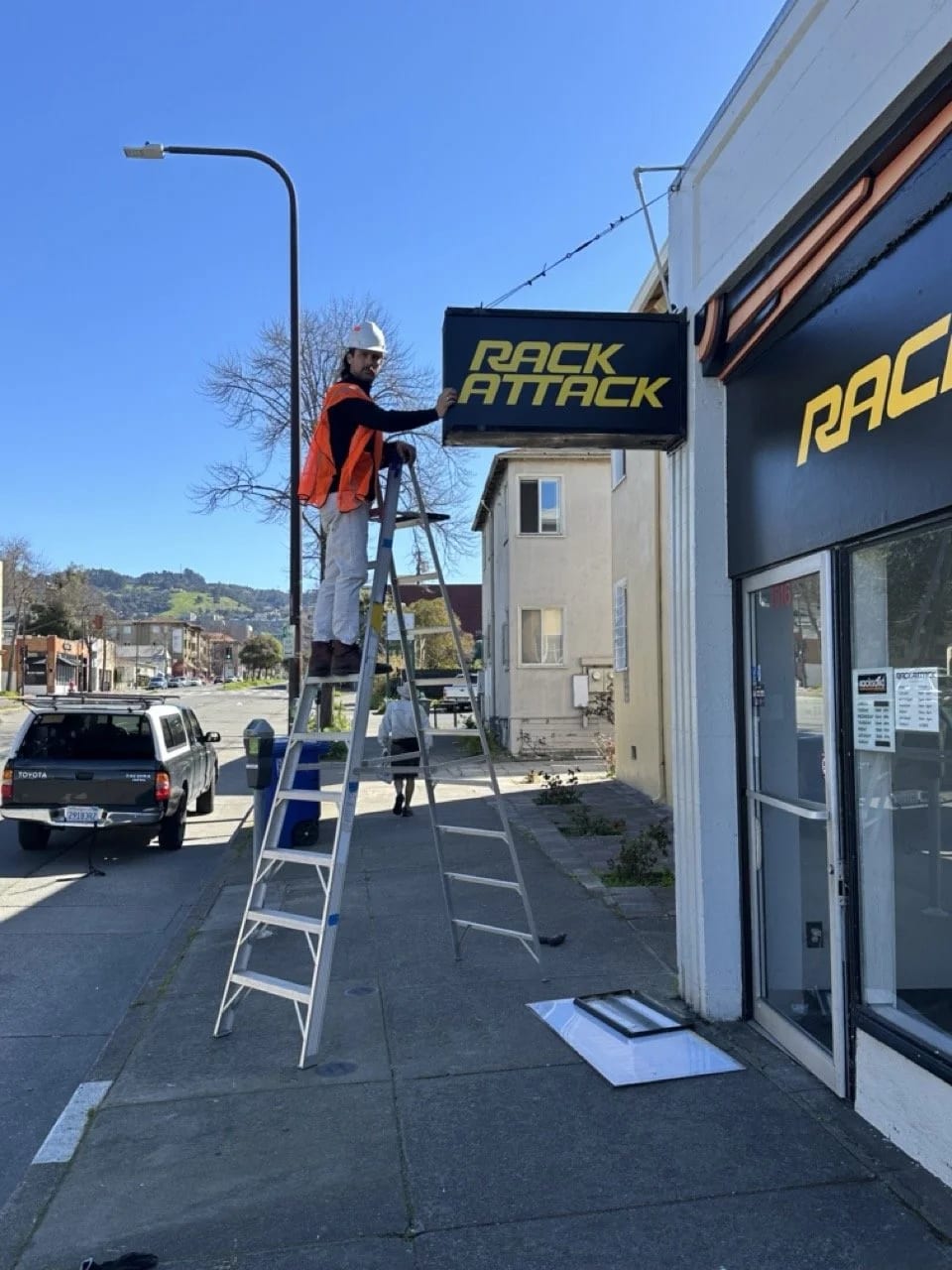
This Rack Attack project is a useful reminder that a storefront sign is not just about branding. It is also about when the sign becomes legible and from what angle. For a retail business in Sacramento, that question matters a lot on streets where customers approach from the sidewalk, from angled parking, or from a shared center drive aisle.
In this case, a projecting blade sign made more sense than relying on a flat wall sign alone. The blade format gives the storefront a visible face from the approach, not just once someone is standing directly in front of the lease space.
Why blade signs work so well on Sacramento storefronts
Many local storefronts have one of three visibility problems: shallow frontage, a sign band that sits above eye level, or neighboring storefronts that visually compete for attention. A blade sign helps because it changes the angle of the message. Instead of asking people to look straight at the building, it meets them as they move past it.
That makes blade signs especially useful for retail strips, pedestrian-oriented corridors, and businesses that need to be spotted quickly by customers who are already scanning for an address or suite.
What had to be right on this installation
Projects like this depend on more than a good-looking face panel. The installation only feels clean when the whole assembly is planned together:
- Bracket location: The sign has to sit where it reads clearly without feeling jammed against trim, awnings, or neighboring storefront elements.
- Projection and clearance: It needs enough reach to be useful, but not so much that it creates a circulation or compliance problem.
- Mounting surface: The wall construction determines what hardware makes sense and how loads are distributed.
- Panel fit: The acrylic panel has to sit cleanly inside the frame so the finished sign looks deliberate, not improvised.
Why the projecting format mattered more than size alone
One of the most common storefront mistakes is assuming a bigger flat sign solves every visibility issue. It usually does not. If the angle is wrong, more square footage just creates a larger sign that still appears late in the customer journey.
A projecting sign changes that. It gives the business a readable marker earlier, which is often more useful than simply increasing the width of the fascia sign.
Material and fabrication choices still matter
The face panel on a blade sign does not live in isolation. Sacramento heat, UV exposure, dust, and everyday street grime all work on the materials over time. That is why the panel, frame, coatings, and hardware have to be chosen as a system.
For this style of sign, the polished look comes from keeping the details tight: good panel fit, stable hardware, clean edges, and a bracket assembly that feels proportionate to the storefront rather than oversized for it.
Landlord review and sign planning should happen early
Projecting signs are often more review-sensitive than simple wall graphics. Shopping centers and commercial landlords may care about projection limits, bracket style, finish color, sign area, and how the sign lines up with neighboring tenants. Municipal review may also come into play depending on the site.
That is why we prefer treating a blade sign as part of the main storefront package, not as an afterthought added at the end of the job.
What businesses can learn from this Rack Attack install
If your storefront is hard to spot from the approach, a blade sign may be doing the real visibility work even if the fascia sign carries more branding. The right question is not “Can we fit one?” It is “Would a projecting sign solve the way people actually encounter this storefront?”
For many Sacramento retail businesses, the answer is yes, especially when the storefront depends on walk-up traffic, shared-center traffic, or quick visual recognition from a busy corridor.
If you are planning a projecting storefront sign, start your project. We can help sort through sign type, bracket approach, site review, and installation before the job turns into a patchwork of late decisions.
FAQ
Why choose a blade sign instead of only a wall sign?
A blade sign faces approaching foot traffic and slow-moving vehicle traffic more effectively than a sign mounted flat to the facade. On many Sacramento storefronts, that extra visibility is the difference between being noticed early and being seen only after someone has already passed the suite.
What should be checked before installing a blade sign?
Start with landlord criteria, sign-zone rules, pedestrian clearance, bracket load, and the actual wall construction. You also want to confirm how far the sign can project without conflicting with adjacent tenants, trees, lighting, or awnings.
Are acrylic blade signs durable enough for Sacramento storefronts?
Yes, when the panel, frame, and mounting system are chosen correctly. Acrylic or plexiglass panels can work well for Sacramento conditions, but the hardware, edge protection, and overall bracket system need to match the exposure and traffic of the site.
Do blade signs usually need permits?
Often, yes. Requirements vary by city, shopping center, and building type, so projecting signs should be reviewed early in the process rather than treated like a simple last-minute add-on.